Weed Control · Texas
How to Get Rid of Crabgrass in Your Lawn in Texas (2026 Guide)
Texas edition: Why crabgrass keeps returning, which product works once it's already up, and the one application that prevents next year's crop entirely. Tailored for Bermuda lawns and Texas growing conditions.
In this guide5 sections
Crabgrass is the weed people fight hardest and lose to most often — not because it is difficult to kill, but because most people fight it in the wrong month with the wrong product. It is a summer annual grass: it germinates from seed each spring, grows aggressively through the heat, drops an enormous seed load, then dies at the first frost. Everything about controlling it follows from that one fact.
Make Sure It Is Crabgrass
Several grassy weeds get called crabgrass, and two of them need completely different treatment — so spend thirty seconds here.
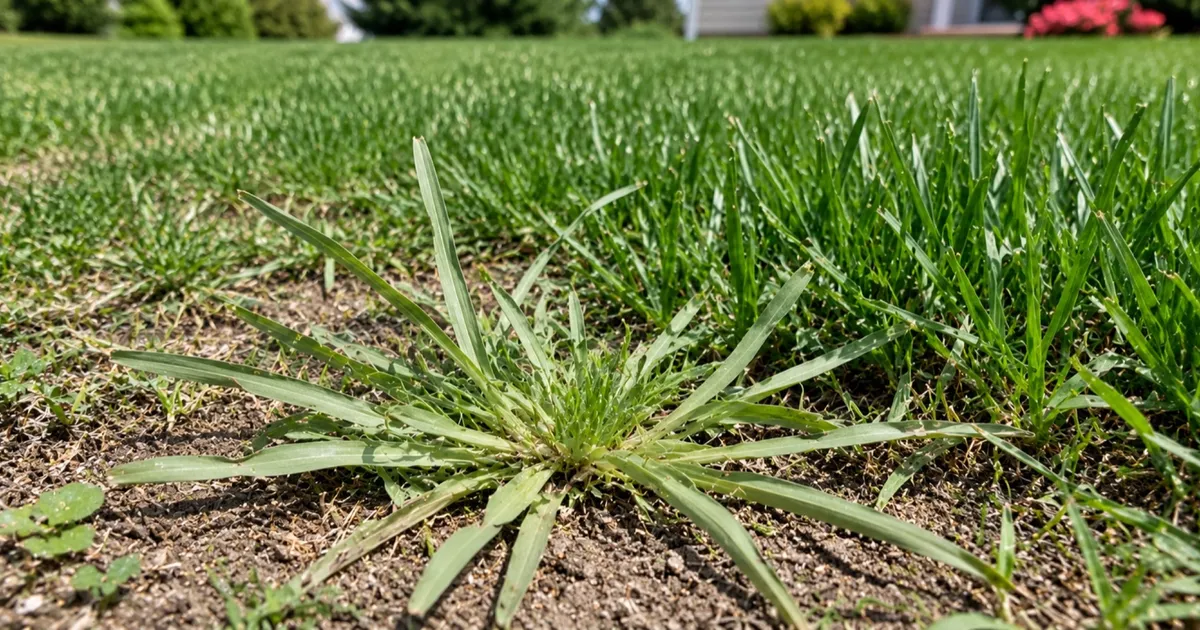
Crabgrass looks like this: coarse, light-green blades growing outward from a single central crown in a low fan or star, hugging the ground rather than standing upright. Stems often root where they touch soil. Seedheads have several finger-like spikes radiating from one point — the “crab” in the name.
What it is not:
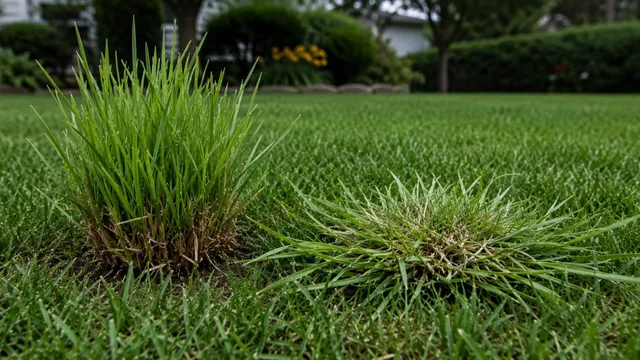
- Dallisgrass grows from a tough perennial crown in a tight clump, comes back from the same spot every year, and shrugs off products that flatten crabgrass. If your “crabgrass” reappears in the identical place each season, read our dallisgrass vs crabgrass comparison.
- Goosegrass has a distinctive whitish, flattened center where the blades meet, and prefers compacted ground.
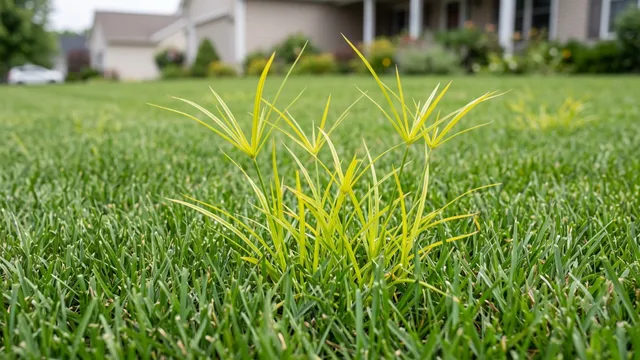
- Nutsedge looks grass-like but has a triangular stem and grows faster than the lawn — and needs an entirely different product. See how to get rid of nutsedge.
For the full three-family framework, the weed identification guide covers how to sort any lawn weed in under a minute.
Texas Lawn Threat Matrix
What to scout for on Bermuda lawns in USDA zones 6b–9b.
High-Risk Weeds
- Crabgrass
- Dallisgrass
- Nutsedge
- Henbit
- Spurge
- Grassbur (sandbur)
- Rescuegrass
High-Risk Diseases
- Brown patch / large patch
- Take-all root rot
- Gray leaf spot (St. Augustine)
- Dollar spot
- Spring dead spot (Bermuda)
Common Pests
- Chinch bugs
- White grubs (June beetle larvae)
- Fire ants
- Fall armyworms
- Bermudagrass mites
Killing Crabgrass That Is Already Up
Two honest options, and one product category that will waste your money.
What works: a quinclorac-based post-emergent. Quinclorac is selective between grass species — it kills crabgrass while established lawn grasses tolerate it. Most homeowner bottles combine it with a three-way broadleaf mix so one pass handles crabgrass plus dandelion and clover.
What does not work: a standard three-way broadleaf herbicide on its own. 2,4-D, dicamba and MCPP target broadleaf plants. Crabgrass is a grass. You can spray it three times and watch it keep growing — this is the single most common “my weed killer is defective” story in lawn care.
Two details decide whether the application succeeds:
- Plant age matters enormously. A young seedling with two or three leaves dies from one treatment. A late-summer plant with many tillers may survive two or three. Treat early, not when it is obvious.
- Temperature matters. Like all 2,4-D blends, these products risk turf injury above roughly 85–90°F. Your local window: April–early June and September–October; avoid herbicides above 90°F

For Crabgrass Already Up
Ortho Weed B Gon Plus Crabgrass Control
★★★★★ (4.5/5)
The one homeowner bottle that kills crabgrass already up AND common broadleaf weeds — quinclorac is what standard three-way mixes are missing.
Best for: Emerged crabgrass, plus broadleaf weeds in the same pass
$20–$28
Read our review⚖️ Texas rules that affect this application. Stage 2+ drought restrictions in many cities limit watering-in of granular products On the fertilization side, which matters because feeding is part of crowding crabgrass out: No statewide fertilizer blackout, but many municipalities restrict fertilizing before forecast heavy rain County ordinances can be stricter than state rules — check with your local extension office before treating near water.
The Application That Actually Ends It
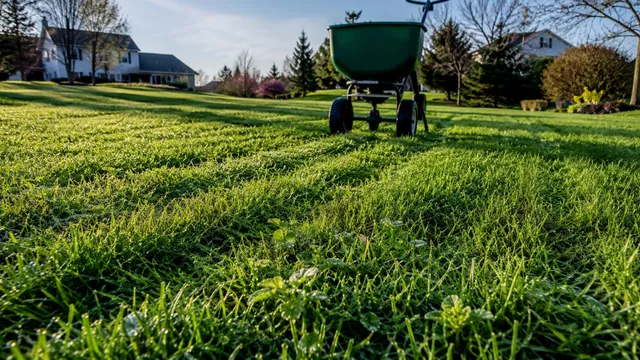
Here is the part that changes your lawn permanently: crabgrass is a prevention problem, not a treatment problem. One properly timed pre-emergent application stops the entire year’s germination for a few dollars per thousand square feet — less than a single bottle of post-emergent, with none of the spraying.
Pre-emergent works by creating a chemical barrier in the top layer of soil that kills seeds as they germinate. Two consequences follow:
- It must be down before germination. Crabgrass germinates when soil temperature holds around 55°F for several consecutive days — typically two to three weeks before you would notice anything.
- It blocks grass seed too. Do not overseed for several months after applying, and do not apply pre-emergent to an area you intend to seed.
The Crabgrass Prevention Sequence
Apply pre-emergent before germinationLate February (South TX) to mid-March (North TX), soil temps 55°F for crabgrass
Prodiamine or dithiopyr at the labeled rate. Water in with about a half inch of irrigation to activate the soil barrier — an unwatered application is an unused application.
Treat the hot edges earlier1–2 weeks before the main application
Soil next to driveways, sidewalks and south-facing walls warms first, so crabgrass germinates there first. Treating those strips slightly earlier closes the gap most people miss.
Split the application for a longer season6–8 weeks after the first
A second, lighter application extends the barrier through the full germination window. This matters most in long growing seasons where a single application runs out in midsummer.
Spot-treat escapes with quincloracApril–early June and September–October; avoid herbicides above 90°F
Some seedlings always get through. Spot-treating a few young plants is trivial; letting them mature into seed-producing clumps restocks the seed bank for next year.
Mow high all seasonEvery mowing
Crabgrass seed needs light at the soil surface to germinate. Taller turf shades it out, which is genuinely effective rather than filler advice — it is the cheapest control you have.
Close the bare spotsMay–July for Bermuda; avoid establishment during August heat
Every open patch is where next year's crabgrass starts. Overseed or plug inside your regional establishment window — and note the pre-emergent conflict: you cannot do both in the same window.
Prevention — The Real Answer
Barricade (generic) Prodiamine 65 WDG
★★★★★ (4.7/5)
The longest-lasting residential pre-emergent. One properly timed application protects most lawns through the entire spring germination window.
Best for: Stopping the entire season's crabgrass germination in one application
$24–$60
Read our reviewFor the full seasonal picture including winter annuals and the fall application, see our spring weed control guide.
Why It Keeps Coming Back
If crabgrass returns every summer despite treatment, one of these is the reason:
- The pre-emergent went down late. This is the most common cause by a wide margin. Soil temperature — not the calendar, not the forsythia, not last year’s date — determines the window, and it shifts two to three weeks year to year.
- It was never watered in. The barrier only forms once moisture moves the product into the soil surface.
- You seeded and prevented in the same season. They are mutually exclusive; pick one per window.
- You treated mature plants. By the time a clump is obvious it has usually already set seed, so killing it is cosmetic — the seed bank is already loaded.
- The turf is too thin to compete. In Texas, compaction-prone soil limits rooting and thins the stand under traffic, so annual core aeration is part of weed control, not separate from it.
Prevention, Long Term
Crabgrass pressure drops year over year when the seed bank stops being replenished and the canopy stays closed:
- Never let a plant set seed. One escaped clump undoes a season of prevention.
- Mow at the top of your grass type’s range through the germination window.
- Water deeply and infrequently so turf roots go down and the surface dries between cycles.
- Feed on your regional schedule — dense turf blocks light at soil level. The Texas window is Late April after full green-up, June, and early September.
- Aerate compacted areas annually, especially along paths and parking strips.
Three consecutive seasons of correctly timed pre-emergent plus a dense canopy will take most lawns from a summer-long fight to occasional spot treatment.
Common questions
Frequently Asked Questions
What kills crabgrass but not grass?
Quinclorac is the active ingredient homeowners want for crabgrass that has already emerged — it kills the crabgrass while leaving established lawn grasses standing. Standard three-way broadleaf herbicides (2,4-D, dicamba, MCPP) have no meaningful effect on it, which is the most common reason people think their weed killer failed.
Will crabgrass die on its own in winter?
Yes — crabgrass is a summer annual and the first hard frost kills every plant. The problem is what it leaves behind: a single plant can drop tens of thousands of seeds that sit in your soil waiting for next spring. Killing it in September accomplishes very little; preventing germination next March is what changes the outcome.
Can I pull crabgrass out?
For a handful of plants, yes — pull from moist soil and take the whole crown. But every pulled plant leaves an open patch of bare soil, which is exactly the condition crabgrass seeds need, so fill the gap with seed or a plug or you have simply prepared next year's nursery.
Is it too late to apply pre-emergent if I already see crabgrass?
For this season's crop, yes — pre-emergent stops seeds during germination and does nothing to a plant you can already see. Switch to a quinclorac post-emergent now, then put the pre-emergent calendar reminder in place for next spring. A fall application still helps against winter annuals.
Why do I get crabgrass along my driveway and sidewalk?
Concrete and asphalt absorb heat and warm the adjacent soil several degrees above the rest of the lawn, so seeds there germinate earlier and grow faster. Those strips are also usually the driest and thinnest turf in the yard. Treat edges first and consider a slightly earlier pre-emergent application there.
Verify our work
📚 Sources & Further Reading
This guide is written against published land-grant university extension research and USDA data. Verify local details with your own state's extension office — and always follow the product label.
- [1]Crabgrass — University of Maryland Extension(extension.umd.edu)
- [2]Weed Control in Home Lawns (B978) — University of Georgia Extension(extension.uga.edu)
- [3]Turfgrass Weeds — Texas A&M AgriLife Extension — Aggie Turf(aggieturf.tamu.edu)
- [4]Herbicide Options for Managing Common Lawn Weeds — University of Maryland Extension(extension.umd.edu)
- [5]Weed Management Guide for Florida Lawns (ENH884/EP141) — University of Florida IFAS Extension(edis.ifas.ufl.edu)
Spotted an error? Tell us — we correct verified mistakes and note the revision date. See oureditorial policy.