Weed Control · Georgia
Dallisgrass vs Crabgrass: How to Tell Them Apart in Georgia (2026 Guide)
Georgia edition: They look alike and need opposite strategies. One dies at frost; the other returns from the same crown for years. Here's how to tell, and what to do. Tailored for Bermuda lawns and Georgia growing conditions.
In this guide4 sections
Two grassy weeds, nearly identical at a glance, requiring opposite strategies. Mistaking one for the other is why some people spray the same patch for three summers and never win: they are applying an annual-weed playbook to a perennial plant.
The Four Checks That Settle It
Work down this list. Any single one is usually decisive.
1. Growth habit — the fastest tell
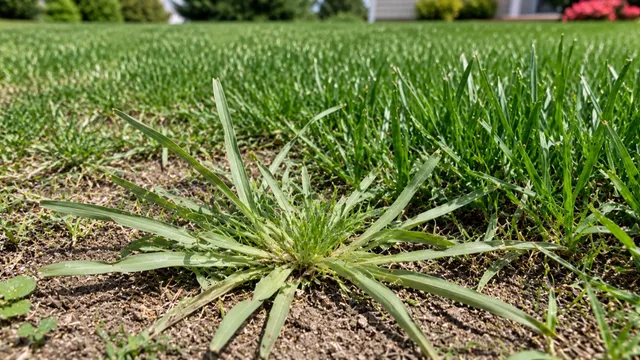
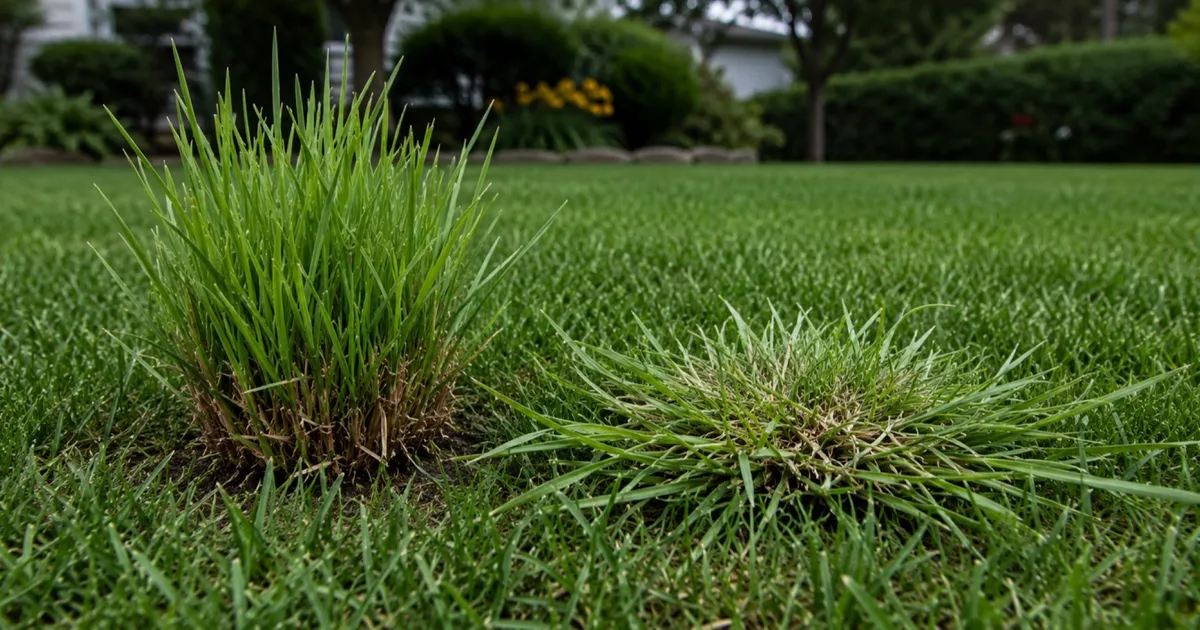
Crabgrass sprawls. Blades radiate outward from one central point in a low fan or star, pressed close to the ground, and stems often root where they contact soil.
Dallisgrass stands up. It forms a tight, upright clump — a distinct tuft that sits noticeably above the mow line rather than spreading sideways.
2. The base of the plant
This is the definitive check. Part the blades and look at where they meet the soil.
Crabgrass has a soft, fibrous crown you can pull apart with your fingers.
Dallisgrass has a thick, woody, almost knotted crown — a perennial structure that stores energy through winter, often with short rhizomes radiating from it. It resists pulling, and if you do pull it, it tends to break rather than lift.
3. Does it return to the same footprint?
Crabgrass cannot. Every plant dies at frost and next year’s plants grow from scattered seed, so the pattern moves around the lawn.
Dallisgrass does. The same clump regrows from the same crown, in the same place, for years. This history question alone identifies it in most yards.
4. Seedheads
Crabgrass produces several finger-like spikes radiating from one point at the top of a stem.
Dallisgrass sends up taller seed stalks bearing sparse paired branches, often with small dark spots visible on the seed, and it produces them persistently through the season even in mown turf.
For sorting any lawn weed into its family first, start with the weed identification guide.
Georgia Lawn Threat Matrix
What to scout for on Bermuda lawns in USDA zones 7a–9a.
High-Risk Weeds
- Crabgrass
- Doveweed
- Virginia buttonweed
- Dallisgrass
- Annual bluegrass (Poa annua)
- Lespedeza
High-Risk Diseases
- Large patch (Zoysia and centipede)
- Dollar spot
- Spring dead spot (Bermuda)
- Take-all root rot
- Centipede decline syndrome
Common Pests
- Fire ants (statewide, year-round mounds)
- Fall armyworms (late-summer outbreaks)
- Two-lined spittlebugs (centipede specialist)
- White grubs
- Chinch bugs (St. Augustine on the coast)
Why the Difference Changes Everything
The annual-versus-perennial distinction determines which tools can work at all.
| Crabgrass | Dallisgrass | |
|---|---|---|
| Life cycle | Summer annual — dies at frost | Perennial — crown survives winter |
| Spreads by | Seed only | Seed and short rhizomes from the crown |
| Pre-emergent | The primary control | Little effect on established plants |
| Post-emergent | Quinclorac works well on young plants | Suppression only; repeat applications |
| Hand removal | Easy from moist soil | Must excavate the whole crown |
| Realistic goal | Prevention — genuinely achievable | Containment, or spot-kill and replant |
The practical consequence: a pre-emergent program that eliminates crabgrass from a lawn in two or three seasons will leave a dallisgrass clump completely untouched. If you have been “winning against everything except that one patch,” that patch is the perennial.
Why these two do well in Georgia specifically: your soils are red georgia clay, described as slow — dense clay compacts under traffic and bakes brick-hard in august. Dallisgrass in particular tolerates the wet, compacted conditions that thin turf roots, so it colonizes low spots and traffic lanes long before it appears in healthy areas — which is why core aeration belongs in your weed plan, not just your maintenance plan.Treating Dallisgrass, Honestly
This is where most lawn content oversells, so here is the straight version.
The product that used to be the answer is gone. MSMA was the standard residential dallisgrass control and it is no longer permitted for use on home lawns — remaining registrations are limited to professional settings such as golf courses and sod production. Any advice that still recommends it for your yard is out of date.
Your state's rules confirm it: MSMA banned for residential turf — professional sod/golf use onlyWhat is realistically available to a homeowner:
- Repeat quinclorac applications. Products containing quinclorac suppress dallisgrass with mixed and often modest results. Expect several applications across a season, spaced per the label, and expect regrowth from the crown.
- Excavation for isolated clumps. For a handful of plants this is the most reliable route. Dig several inches wider and deeper than the clump to remove the entire crown and surrounding rhizomes, then refill and replant.
- Spot-kill and renovate. For heavier infestations, most extension guidance converges here: treat the clumps with a non-selective herbicide, confirm a complete kill, observe the label’s replant interval, then re-establish turf.
Dallisgrass Containment Plan
Confirm the crown before spending anythingToday
Part the blades and feel the base. Woody and knotted with short rhizomes means dallisgrass, and it means pre-emergent is not your tool. Soft and fibrous means crabgrass — treat it as crabgrass instead.
Excavate isolated clumpsAny time soil is workable
Dig wide and deep enough to lift the whole crown intact. Fragments resprout, so err generous. This beats spraying for small numbers of plants.
Suppress the rest with quincloracApril to early June and September–October; avoid mid-summer sprays on stressed turf
Follow the label's repeat interval and expect suppression rather than eradication. Do not exceed labeled annual totals in pursuit of a faster result.
Spot-kill and replant heavy patchesSod or sprig warm-season lawns May through July
Non-selective treatment, verified kill, then replant inside your regional establishment window. Doing this outside the window is how people end up renovating twice.
Close the gap immediatelyRight after replanting
A bare patch left open becomes a crabgrass nursery. Seed or plug it and keep it moist until established — you do not want to trade one grassy weed for another.
Return to pre-emergent for the annualsLate February to mid-March in Atlanta (soil 55°F), with a second application in May for season-long control
With the perennial clumps handled, a timed pre-emergent keeps crabgrass and other summer annuals out of the repaired areas.

Suppression + Crabgrass
Ortho Weed B Gon Plus Crabgrass Control
★★★★★ (4.5/5)
The one homeowner bottle that kills crabgrass already up AND common broadleaf weeds — quinclorac is what standard three-way mixes are missing.
Best for: Emerged crabgrass, and partial suppression of dallisgrass over repeat applications
$20–$28
Read our reviewWarm-Season Lawns, Summer Heat
BASF Celsius WG Herbicide
★★★★★ (4.7/5)
Safe on warm-season turf at temperatures where 2,4-D blends injure grass, and covers a very wide weed list — useful when grassy weeds arrive alongside everything else.
Best for: Southern lawns treating mixed weed pressure through summer
$120–$140
Read our reviewNothing here is a one-application fix for established dallisgrass. Anyone promising that is selling you the pre-ban product or selling you disappointment.
Keeping Both Out
Both weeds exploit the same opening: thin turf with light reaching bare soil.
- Never let either set seed. A single season of seed production reloads the seed bank you have been trying to empty.
- Mow at the top of your grass type’s range. On Bermuda, follow the species range rather than a generic number.
- Water deeply and infrequently so turf roots outcompete shallow-rooted invaders.
- Feed on your regional schedule. In Georgia: Bermuda: monthly light feedings from full green-up (late April) through August.
- Aerate compacted areas annually — both species tolerate compaction better than turf does.
- Scout the same spots each summer. Dallisgrass returns to its footprint, so a photo record of last year’s clumps tells you exactly where to look.
Next steps in this cluster: the full annual sequence in our crabgrass guide, and the sedge that fools everyone in how to get rid of nutsedge.
Common questions
Frequently Asked Questions
How do I tell dallisgrass from crabgrass?
Look at the growth habit and the base. Crabgrass fans outward low against the soil from a soft crown and dies at the first frost. Dallisgrass grows upright in a tight clump from a thick, woody perennial crown, and the same clump returns in exactly the same spot year after year. If your 'crabgrass' comes back in the identical place each season, it is dallisgrass.
Does pre-emergent work on dallisgrass?
Barely. Pre-emergent stops seeds during germination, and while dallisgrass does produce seed, established plants regrow from their perennial crown and short rhizomes — which no seed barrier affects. Pre-emergent is the right tool for crabgrass and close to useless against an existing dallisgrass clump.
What kills dallisgrass in a lawn?
There is no easy homeowner answer, and that is the honest position. MSMA, the product that once handled it, is banned for residential turf. Repeat applications of quinclorac-containing products suppress it with mixed results. For established clumps, most extension guidance points to spot-treating with a non-selective herbicide and replanting the patch once the kill is complete.
Why does my crabgrass come back in the same spot every year?
Because it almost certainly is not crabgrass. Crabgrass is an annual — every plant dies at frost and next year's plants grow from seed, which scatters. A weed returning to the identical footprint season after season is regrowing from a perennial crown, and dallisgrass is the usual culprit in warm-season and transition-zone lawns.
Can I just dig dallisgrass out?
For a few isolated clumps this is genuinely the most reliable option. Dig several inches wider and deeper than the clump to get the whole crown and the short rhizomes around it — fragments left behind resprout. Then fill the hole with soil and seed or a plug, because a bare patch invites crabgrass next.
Verify our work
📚 Sources & Further Reading
This guide is written against published land-grant university extension research and USDA data. Verify local details with your own state's extension office — and always follow the product label.
- [1]Dallisgrass — NC State Extension(content.ces.ncsu.edu)
- [2]Dallisgrass — University of Maryland Extension(extension.umd.edu)
- [3]Crabgrass — University of Maryland Extension(extension.umd.edu)
- [4]Turfgrass Weeds — Texas A&M AgriLife Extension — Aggie Turf(aggieturf.tamu.edu)
- [5]Weed Control in Home Lawns (B978) — University of Georgia Extension(extension.uga.edu)
Spotted an error? Tell us — we correct verified mistakes and note the revision date. See oureditorial policy.