Weed Control · Georgia
How to Get Rid of Nutsedge in Your Lawn in Georgia (2026 Guide)
Georgia edition: Nutsedge ignores ordinary weed killer because it isn't a weed you can treat that way. Here's the product that works and the moisture problem behind it. Tailored for Bermuda lawns and Georgia growing conditions.
In this guide6 sections
If you have sprayed weed killer twice and one weed is still standing taller than the rest of your lawn days after mowing, you almost certainly have nutsedge — and the products in your shed were never going to work on it. Nutsedge is not a broadleaf weed and not a true grass. It is a sedge, a separate plant family, and it needs its own chemistry.
Confirm It Is Actually Nutsedge
Three checks, about twenty seconds. Getting this right is the whole article, because the wrong identification is why most people waste two products.
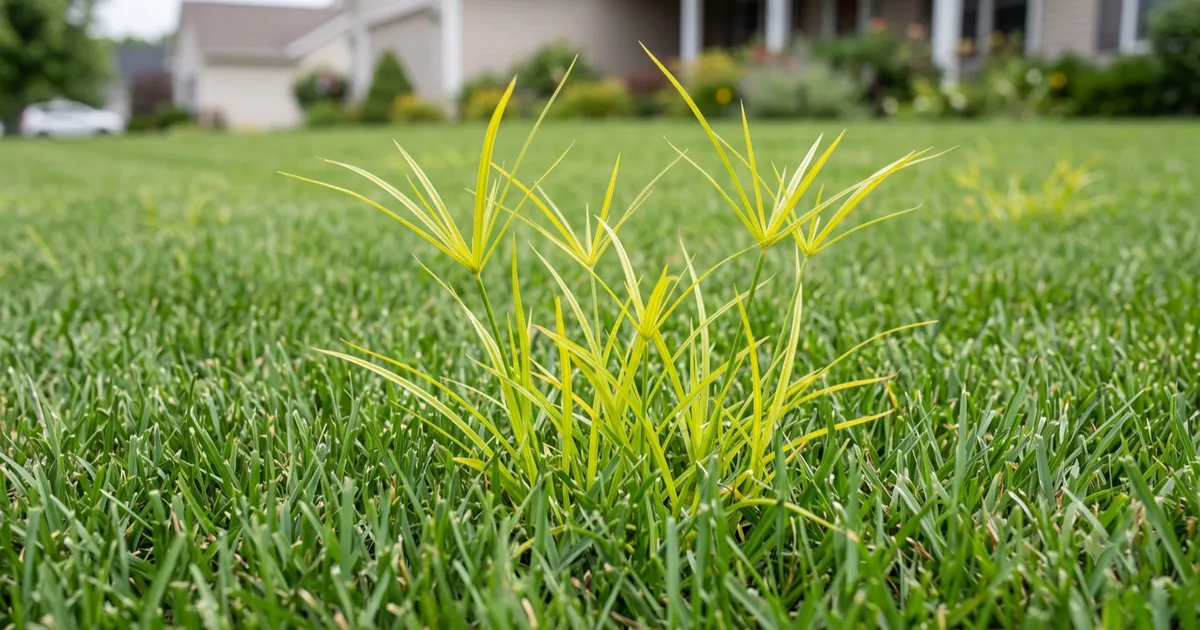
- Roll the stem between your fingers. Nutsedge stems are triangular — you can feel three distinct flat faces. Every true grass has a round or flattened stem. This single test is definitive.
- Watch the height after mowing. Nutsedge grows noticeably faster than turf, so it stands above the canopy two or three days after you cut.
- Look at the color and shine. The blades are a glossy, light yellow-green that reads brighter than surrounding grass, with a distinct crease down the center and a sharply pointed tip.
Yellow nutsedge is the species most homeowners meet; purple nutsedge is darker, more aggressive and more common in the Deep South. Green kyllinga looks similar but forms low dense mats rather than upright shoots — the same products control it.
If you are unsure, the family question in our Lawn Health Analyzer walks through these checks, and the weed identification guide covers how sedges differ from the other two families.
Regional note: nutsedge is not among the weeds Georgia extension programs flag as highest-pressure, so an outbreak here usually points at a specific wet spot — a leaking head, a low area or a downspout — rather than general regional pressure.Georgia Lawn Threat Matrix
What to scout for on Bermuda lawns in USDA zones 7a–9a.
High-Risk Weeds
- Crabgrass
- Doveweed
- Virginia buttonweed
- Dallisgrass
- Annual bluegrass (Poa annua)
- Lespedeza
High-Risk Diseases
- Large patch (Zoysia and centipede)
- Dollar spot
- Spring dead spot (Bermuda)
- Take-all root rot
- Centipede decline syndrome
Common Pests
- Fire ants (statewide, year-round mounds)
- Fall armyworms (late-summer outbreaks)
- Two-lined spittlebugs (centipede specialist)
- White grubs
- Chinch bugs (St. Augustine on the coast)
Why Your Weed Killer Did Nothing
Herbicide labels are organized around plant families, and sedges sit outside the two families that homeowner products target.
- Three-way broadleaf herbicides (2,4-D, dicamba, MCPP) work on plants with broad leaves and branching veins. Nutsedge has neither.
- Crabgrass and grassy-weed products (quinclorac and similar) are built for true grasses. Nutsedge is not one.
- Pre-emergent herbicide stops seeds as they germinate. Nutsedge spreads primarily from tubers already in your soil, so a seed barrier misses the actual reproduction route.
That leaves two active ingredients that genuinely work in turf: halosulfuron and sulfentrazone. Read for the active ingredient rather than the marketing on the front of the bottle — “kills tough weeds” tells you nothing about whether it lists sedges.
The Nutsedge Removal Plan
Nutsedge Removal Plan
Treat while plants are youngApril to early June and September–October; avoid mid-summer sprays on stressed turf
Young shoots that have not yet built a full tuber network die far more readily than a mature stand. Extension guidance generally puts the first application at roughly 6–8 inches of vigorous growth.
Add a non-ionic surfactantSame application
Sedge blades are waxy and shed spray readily. Where the label calls for a surfactant, it is not optional — it is the difference between the product sitting on the leaf and being absorbed.
Spot-treat, don't blanket-spraySame application
Nutsedge grows in discrete clumps, so spot treatment costs less, keeps the product off healthy turf and works just as well. Confirm your grass species is listed on the label first.
Expect and plan the second pass3–6 weeks later
Dormant tubers sprout after the first treatment removes the plants above them. A follow-up application on the new shoots is the normal course of treatment, not a failure of the first one.
Fix the moisture problemThis month
Audit irrigation run times, check for a leaking head or a chronically wet low spot, and correct drainage. Without this, the tubers left in the soil simply repopulate the same patch next season.
Thicken the turf over itBermuda: monthly light feedings from full green-up (late April) through August
Dense turf shades the soil surface and slows tuber sprouting, which steadily reduces how much you need to spray in future years.
Products That Actually Work
Label safety for your lawn: Georgia lawns are predominantly Bermuda. Halosulfuron is labeled for all the major US turf species including Bermuda, which makes it the safe default here. Celsius WG below is also safe on Bermuda and stays usable in summer heat, which matters in Georgia.
The Standard Choice
SedgeHammer SedgeHammer Halosulfuron 75 WDG
★★★★★ (4.6/5)
Standard herbicides don't touch nutsedge. Halosulfuron kills yellow and purple nutsedge down to the tuber without injuring turf.
Best for: Yellow and purple nutsedge in any common US turf
$25–$35
Read our reviewWarm-Season Lawns, Summer Heat
BASF Celsius WG Herbicide
★★★★★ (4.7/5)
Controls sedges alongside 150+ other weeds and stays safe on warm-season turf at temperatures where 2,4-D products cause injury — useful when nutsedge arrives with everything else.
Best for: Southern lawns fighting nutsedge plus mixed weed pressure
$120–$140
Read our reviewA word on what not to buy: any product marketed as killing “all weeds and grasses” is non-selective and will leave a dead patch in your lawn. And a standard three-way broadleaf herbicide, however many times you apply it, will not control this plant.
⚖️ Before you apply anything in Georgia. Atrazine label restrictions apply on sandy coastal soils near waterways Also worth knowing: MSMA banned for residential turf — professional sod/golf use only Local ordinances can be stricter than state rules, so check with your county extension office if you are treating near water or on a rental property.
Fix the Water, or It Comes Back
Nutsedge is an indicator species. Extension guidance is consistent on this point: it favors soils that stay wetter than turf prefers. Treat the plant and ignore the cause, and the tubers in your soil will simply produce a new stand.
- Audit irrigation. Water deeply and infrequently rather than daily. A short daily cycle keeps the top inch of soil continuously moist, which is precisely the condition nutsedge exploits.
- Find the leak. A single misaligned or weeping sprinkler head explains a surprising share of isolated nutsedge patches.
- Correct low spots. Areas that pond after rain need grading or top-dressing, not more herbicide.
- Relieve compaction. Core aeration improves infiltration so water moves down through the profile instead of sitting at the surface.
- Never till infested soil. Tilling chops and distributes tubers, turning one patch into a field.
What to Expect
Nutsedge is controllable but rarely a one-application job, and honest expectations prevent people from concluding the product failed:
- 2–3 weeks — visible yellowing and decline of treated shoots.
- 3–6 weeks — new shoots appear from dormant tubers; this is expected. Apply the follow-up.
- One full season — a well-treated patch with corrected drainage usually stops recurring, though tubers can persist in soil for years, so keep scouting the same spot each summer.
For the wider timing picture — including the pre-emergent work that handles the annual grasses nutsedge often arrives alongside — see our spring weed control guide.
Common questions
Frequently Asked Questions
What kills nutsedge but not grass?
Halosulfuron and sulfentrazone are the two active ingredients that selectively kill nutsedge in lawns. Standard three-way broadleaf herbicides and crabgrass products have essentially no effect on it, because nutsedge is a sedge rather than a broadleaf weed or a true grass. Look for halosulfuron on the label, not a brand promise.
Why does nutsedge keep coming back after I pull it?
Because pulling removes the shoot and leaves the tubers. A single yellow nutsedge plant can produce dozens of underground tubers, and each one can sprout a new plant. That is also why tilling infested soil makes the problem worse — it spreads the tubers around.
Is nutsedge a sign of a lawn problem?
Almost always yes: it signals excess soil moisture. Chronic overwatering, poor drainage, a low spot that stays saturated or a leaking irrigation head all favor nutsedge over turf. If you treat the plant without fixing the water, it returns.
How long does it take to kill nutsedge?
Expect two to three weeks for visible decline after a halosulfuron application, and plan on a second pass three to six weeks later as dormant tubers sprout. That follow-up is normal, not a sign the first treatment failed.
Can I use Roundup on nutsedge in my lawn?
Only if you intend to kill the surrounding grass too. Glyphosate is non-selective, so on a lawn it leaves a dead patch that weeds recolonize. Reserve it for hardscape cracks or an area you plan to fully replant, and use a sedge-specific selective product in turf.
Verify our work
📚 Sources & Further Reading
This guide is written against published land-grant university extension research and USDA data. Verify local details with your own state's extension office — and always follow the product label.
- [1]Yellow Nutsedge — University of Maryland Extension(extension.umd.edu)
- [2]Controlling Sedges in Landscape Plantings — NC State Extension(content.ces.ncsu.edu)
- [3]Herbicide Options for Managing Common Lawn Weeds — University of Maryland Extension(extension.umd.edu)
- [4]Turfgrass Weeds — Texas A&M AgriLife Extension — Aggie Turf(aggieturf.tamu.edu)
- [5]Weed Management Guide for Florida Lawns (ENH884/EP141) — University of Florida IFAS Extension(edis.ifas.ufl.edu)
Spotted an error? Tell us — we correct verified mistakes and note the revision date. See oureditorial policy.